

Sanderling vs Purple Sandpiper
Calidris alba versus Calidris maritima
Play a quiz with Sanderling and Purple Sandpiper
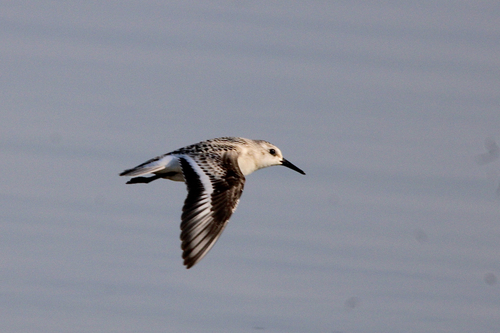 Sanderling
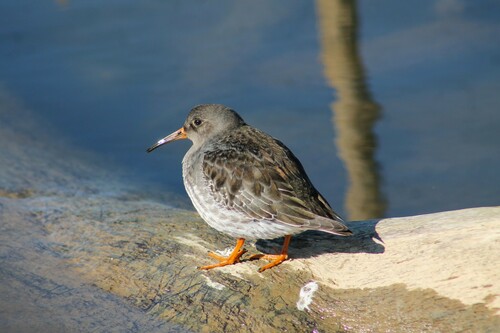 Purple Sandpiper
In short
The most reliable way to separate Sanderling from Purple Sandpiper is by leg and bill color: Sanderling always shows black legs and a short, straight black bill, while Purple Sandpiper has yellow-orange legs and a longer, slightly downcurved bill with a yellow base. In flight, Sanderling of all ages shows a strong, broad white wingbar, which Purple Sandpiper lacks. Sanderling is paler overall, especially in winter, with clean white underparts and a silvery look, while Purple Sandpiper is darker, with a smudgy gray breast and a subtle purplish gloss above. Habitat is also a strong clue: Sanderling prefers sandy beaches, while Purple Sandpiper is almost always on rocky shores.
Identification tips
- Leg color: Sanderling always has black legs; Purple Sandpiper has yellow-orange legs. This is often visible even at a distance and works for all ages and seasons.
- Bill shape and color: Sanderling's bill is short, straight, and black. Purple Sandpiper's bill is longer, slightly downcurved, and has a yellow base. This is most obvious at close range but can be seen with good binoculars.
- Flight pattern: Sanderling shows a strong, broad white wingbar in flight, visible on both upper- and underwing. Purple Sandpiper lacks this, showing a more uniform dark wing with only limited pale markings. This is diagnostic for birds in flight of any age.
- Overall coloration: Sanderling is much paler, especially in winter, with clean white underparts and a silvery-gray back. Purple Sandpiper is darker, with a gray or purplish gloss above and a smudgy gray breast and flanks.
- Breast and flank markings: Sanderling has clean, white underparts with little or no breast streaking in winter. Purple Sandpiper always has a gray-smudged breast and some flank markings, even in winter.
- Habitat: Sanderling is almost always found on sandy beaches or open tidal flats. Purple Sandpiper is closely tied to rocky coasts, breakwaters, and jetties, especially in winter. If the bird is on rocks, strongly consider Purple Sandpiper.
- Behavior: Sanderling runs rapidly along the sand, chasing waves and picking at exposed prey. Purple Sandpiper feeds more slowly among rocks and seaweed, often probing into crevices.
- Flock size: Sanderling often forms large, tight flocks on open beaches. Purple Sandpiper is usually in small groups, sometimes mixed with Turnstones, and is more approachable.
- Structure: Sanderling appears stouter and more compact, with a shorter, thicker bill. Purple Sandpiper is slightly longer and heavier, with a longer, thinner, and slightly decurved bill.
- Face pattern: Sanderling has a pale, open face, especially in winter. Purple Sandpiper's face is darker and less contrasting.
- Upperpart gloss: Only Purple Sandpiper has a purplish gloss to the upperparts, but this is subtle and rarely diagnostic at a distance.
- Juvenile/immature birds: The strong white wingbar of Sanderling in flight is still diagnostic. Juvenile Purple Sandpiper is darker and more patterned above but never as pale as Sanderling.
- Voice: Not diagnostic based on available notes.
- Seasonal context: Sanderling is more likely on southern coasts in winter, while Purple Sandpiper is restricted to rocky Atlantic coasts, rarely found far from rocks.
- Pitfalls: Beware of lighting conditions that can make Sanderling look darker or Purple Sandpiper look paler. Always check leg and bill color and habitat for confirmation.
Size
Purple Sandpiper is slightly heavier on average (about 72 g per Wikidata), and marginally longer (20–22 cm length, 42–46 cm wingspan), but the difference is subtle and not always apparent in the field. Both are small, chunky sandpipers, but Sanderling can look a bit stouter and more compact, especially when running. Size alone is not a reliable separator.
Plumage
- Juvenile/First-winter/Immature flight (all ages): Sanderling shows a bold, broad white wingbar in flight, visible on both upper- and underwing. Purple Sandpiper lacks this strong wingbar; its upperwing is more uniformly dark with only limited pale markings.
- Adult winter: Sanderling is very pale, almost white below and silvery-gray above, with little or no breast streaking. Purple Sandpiper is much darker above, with a grayish or purplish gloss, and has a gray-smudged breast and flanks. Underparts are white but the breast and sides are always marked.
- Adult breeding: Sanderling becomes more patterned, with rufous and black on the upperparts, but still shows a clean, pale face and underparts. Purple Sandpiper is darker and less contrasting, with a more uniform upperpart and persistent gray wash on the breast.
- Leg and bill color (all ages): Sanderling always has black legs and a straight, black bill. Purple Sandpiper has yellow-orange legs and a longer, slightly downcurved bill with a yellow base.
Behaviour
Sanderling is highly active, often seen running rapidly along sandy beaches with a distinctive 'bicycling' leg motion, chasing waves and picking at exposed prey. Purple Sandpiper is more deliberate, feeding among rocks, often probing into crevices or seaweed, and is less likely to be seen running after receding waves. Sanderling is gregarious in winter, forming large flocks on open beaches, while Purple Sandpiper forms smaller groups, often with Ruddy Turnstones, and is more approachable and tame on rocky shores.
Habitat
Habitat is a strong separator: Sanderling almost always occurs on sandy beaches or open tidal flats, rarely venturing onto rocks. Purple Sandpiper is closely tied to rocky, seaweed-covered shores, breakwaters, or jetties, especially in winter, and is rarely found on open sand. If you see a small sandpiper on a rocky Atlantic coast in winter, Purple Sandpiper is far more likely; on a sandy beach, Sanderling is the default.