

Mistle Thrush vs Song Thrush
Turdus viscivorus versus Turdus philomelos
Play a quiz with Mistle Thrush and Song Thrush
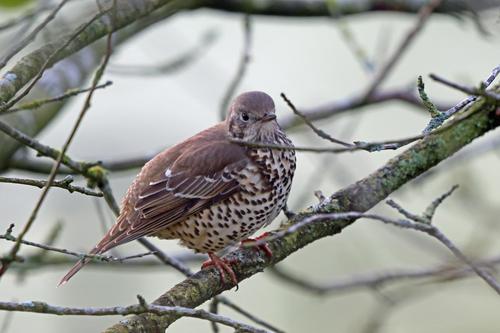 Mistle Thrush
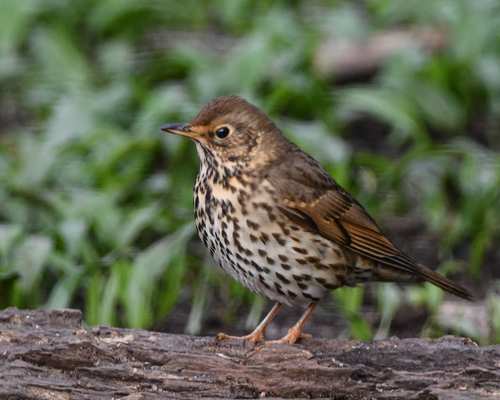 Song Thrush
In short
Mistle Thrush is reliably separated from Song Thrush by its much larger size, paler and greyer overall tone, and bolder, rounder black spots on a yellowish or buff-tinged belly. In the field, Mistle Thrush often appears upright and long-tailed, with white outer tail corners visible in flight, while Song Thrush is smaller, warmer brown above, and shows more orderly, arrow- or heart-shaped spots on cream or buff underparts. Juvenile birds can be confusing, but Mistle Thrush juveniles have paler upperparts with teardrop-shaped pale marks, while Song Thrush juveniles show orange or buff streaks on the back and wing coverts. Spot shape and arrangement, overall size, and the tone of the underparts are the most reliable clues at all ages.
Identification tips
- Size and Structure: Mistle Thrush is much larger and bulkier than Song Thrush, with a longer tail and more upright stance. If you see both together, size is unmistakable.
- Spot Shape and Pattern: Mistle Thrush has bold, round, irregular black spots scattered over a yellowish or buff-tinged belly; Song Thrush has neat, arrow- or heart-shaped spots in orderly rows on cream or buff underparts. This is reliable at all ages.
- Underpart Tone: Mistle Thrush underparts are often more yellowish or buff, especially on the breast, while Song Thrush is paler, creamier, or whiter below. This is especially useful in good light.
- Upperpart Color: Mistle Thrush is pale grey-brown above, while Song Thrush is warm brown. This can be subtle in poor light but is helpful in direct comparison.
- Tail Pattern in Flight: Mistle Thrush shows white tips to the outer tail feathers, visible as white tail corners in flight. Song Thrush lacks this feature.
- Underwing Color: Mistle Thrush has white underwing coverts; Song Thrush shows a warm yellow underwing, which can be seen in flight or when preening.
- Juvenile Plumage: Juvenile Mistle Thrushes have pale upperparts with teardrop-shaped pale marks and smaller spots below; Song Thrush juveniles have orange or buff streaks on the back and wing coverts, and their spots are more elongated and neatly arranged.
- Leg Color: Mistle Thrush legs are yellowish-brown; Song Thrush legs are pinkish. This is subtle but can help at close range.
- Bill Color: Mistle Thrush has a blackish bill with a yellowish base to the lower mandible; Song Thrush has a yellowish bill. Not always visible, but can be useful.
- Posture and Jizz: Mistle Thrush stands upright and often appears alert and long-tailed; Song Thrush is more compact and horizontal.
- Behavior: Mistle Thrush is more likely to be seen in open areas, sometimes in loose flocks, and often flicks its wings and tail. Song Thrush is more secretive and favors denser cover.
- Vocalization: Song Thrush has a loud, musical, and repetitive song, often from a high perch. Mistle Thrush song is harsher and less musical. Calls are less distinctive but can help with experience.
- Habitat Context: In very open ground, especially in winter, Mistle Thrush is more likely, especially if in a group. In dense gardens or woodland, Song Thrush is more typical.
- Seasonal Variation: Both species are resident in much of their range, but Mistle Thrush is more likely to be seen in flocks in autumn and winter.
- Pitfalls: Juvenile Song Thrush can look confusingly pale below, but the spot shape and arrangement remain diagnostic. Beware of pale Mistle Thrush subspecies in the east, but size and spot pattern still separate them.
Size
Mistle Thrush is significantly larger and heavier than Song Thrush. Mistle Thrush measures 27–28 cm in length (some subspecies up to 30 cm) with a wingspan around 45 cm and an average weight of about 130 g. Song Thrush is much smaller, at 20–23.5 cm and 72 g average mass [wikidata]. In the field, Mistle Thrush looks bulkier, longer-tailed, and stands more upright, while Song Thrush is compact and shorter-tailed. Size alone can be diagnostic if both species are seen together.
Plumage
- Juveniles: Mistle Thrush juveniles have paler upperparts with creamy teardrop-shaped centers to the feathers and smaller, rounder spots on yellowish underparts. Song Thrush juveniles have orange or buff streaks on the back and wing coverts, and their underpart spots are more elongated or heart-shaped, arranged in neat lines.
- Adults: Mistle Thrush adults are pale grey-brown above, with a greyish-white chin and throat, yellowish-buff breast, and off-white belly with bold, round, irregular black spots (denser on the lower chest). Song Thrush adults are warm brown above, with cream or yellow-buff underparts, paler on the belly, and neat, arrow- or heart-shaped black spots in regular rows. Mistle Thrush has white outer tail tips and white underwing coverts; Song Thrush shows a warm yellow underwing and pinkish legs.
- Flight: Mistle Thrush shows white tail corners and a pale underwing in flight. Song Thrush shows a yellowish underwing and lacks the white tail corners.
Behaviour
Mistle Thrush often stands upright with a stocky, long-tailed appearance, frequently flicking its wings and tail when excited. It is more likely to be seen foraging on open ground, sometimes in loose flocks, especially outside the breeding season. Song Thrush is more secretive, typically solitary or in pairs, and often forages in denser cover or at woodland edges. Mistle Thrush flight is undulating with glides, while Song Thrush has a more direct, steady flight.
Habitat
Both species overlap widely across Europe and western Asia, but Mistle Thrush prefers more open habitats—parkland, open woodland, and sometimes fields—while Song Thrush is more often found in denser woodland, gardens, and hedgerows. Mistle Thrush may be seen in larger flocks in autumn and winter, especially where food is abundant, while Song Thrush remains more solitary.
Voice
Song Thrush is famous for its loud, clear, musical song with repeated phrases, often delivered from a prominent perch. Its calls include a sharp 'tsip' and a chook-chook alarm. Mistle Thrush has a less musical, harsher song and is less likely to sing from an exposed perch. Song Thrush song is a strong clue in spring and early summer, but both species are more often identified visually.