Motmot

Advanced birding · Lesson 4 · 20 minutes

Terns

Sandwich, Common, Arctic, Roseate, Little, Black, White-winged and Caspian Tern

Terns are the elegant relatives of the gulls. They are lighter, they fly with their bill pointing down, and they dive for fish. In summer you find them on the beach and the pits, and in autumn the juveniles gather in estuaries before the long flight to West Africa and beyond. Arctic Terns winter in Antarctica.

The big trio of Common, Arctic and Roseate Tern is the one that decides a birder's skill: they are almost the same size, nearly the same colour, and they differ in small things, like the bill, the tail and the call. Then come the others: Little Tern, the small one, Sandwich Tern, the big one with a shaggy crest, and the marsh terns, Black and White-winged.

May to August is the time. In spring the Common and Arctic Terns arrive in late April and May, with the biggest numbers going through on the coast. Autumn passage runs from August to October. Black Terns pass inland in May and again in August and September.

Today: 8 birds

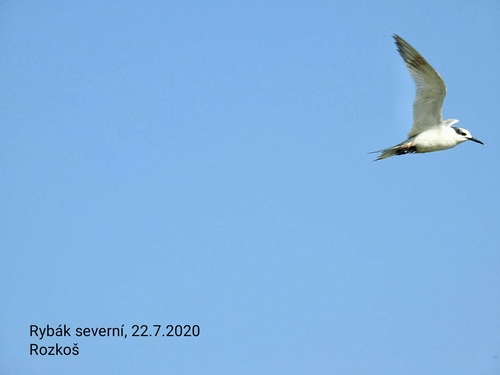
Sandwich Tern, adult adult
Photo: eva_uzdilova · CC BY

Bird 1 of 8

Sandwich Tern

Thalasseus sandvicensis

How to recognise it

  • Big and pale, with a shaggy black cap and a long black bill with a yellow tip
  • Very white, with a short tail and long wings
  • Black legs, and a heavy flight with the bill pointing down
cap The black crown of a tern. In autumn it shrinks to a black mask with a white forehead.

Where and when

NL, DK: fairly common, with colonies on the coast. UK and IE: uncommon, from March to September, mostly in the east and south. BE, DE, FR, NO, SE and FI: scarce to rare. Arrives in March, the first tern, and leaves in October.

Call A loud, grating “kirrick”, like a squeaking door. Recording: Lennart Jeppsson · xeno-canto

The first tern to arrive in spring, often at the end of March. The big size and the pale, white look are enough, and you can pick out the call from far away.

Don’t confuse with: Common Tern (this week): smaller, red bill, and a dark tip, not a yellow one.

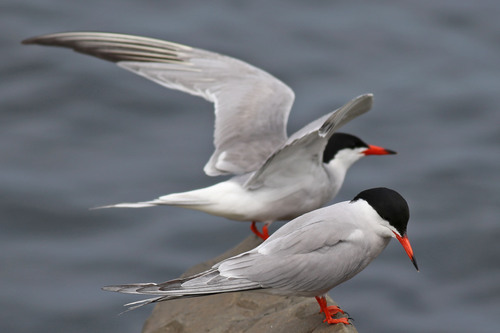
Common Tern, adult adult
Photo: keimwj · CC BY

Bird 2 of 8

Common Tern

Sterna hirundo

How to recognise it

  • Red bill with a black tip, and a black cap
  • Wing tips look dark above, with a dark wedge on the outer primaries
  • Tail is shorter than the folded wing tip, and the legs are orange-red
cap The black crown of a tern. In autumn it shrinks to a black mask with a white forehead.

Where and when

NL, UK, DK, SE, FI: fairly common to common, breeding from May to August. IE, BE, DE, FR: uncommon, with breeding colonies. NO: scarce. Passes in April to May and August to October.

Call A harsh “kee-arr”, with the stress on the last part, and a rapid “kik-kik-kik”. Recording: Arjun Dutta · xeno-canto

The standard tern, and everything else is compared to it. If the bill is red with a black tip, the wings have a dark wedge at the tip, and the tail is short, it is a Common Tern.

Don’t confuse with: Arctic Tern (this week): all-red bill, shorter legs, long tail streamers and a very narrow dark trailing edge.

Arctic Tern, adult adult
Photo: afsarnayakkan · CC BY

Bird 3 of 8

Arctic Tern

Sterna paradisaea

How to recognise it

  • Blood-red bill with no black tip, and very short red legs
  • Long tail streamers that reach beyond the folded wings
  • Translucent flight feathers from below, with a thin, clean, dark edge to the wing
tail streamers The long outer tail feathers of an adult tern. They reach past the wing tip in Arctic and Roseate Terns.
translucent Light shines through. The flight feathers of an Arctic Tern look glassy when seen against the sky.

Where and when

NO, SE: common, with big colonies. IE, DK: uncommon. UK, NL, FI: scarce to fairly common, with strongholds in Scotland and the Wadden Sea. BE, DE, FR: rare, on passage. The longest migration of any bird.

Call A high, ringing “kee-yeah”, a bit more squeaky than a Common Tern. Recording: Niels Van Doninck · xeno-canto

A longer tail, a shorter neck and the red bill make it a more graceful bird. The white wing, with no dark wedge, is the field mark that leaps out.

Don’t confuse with: Common Tern (this week): a black tip to the bill, a dark wedge at the wing tip, and a longer neck.

Common or Arctic Tern?

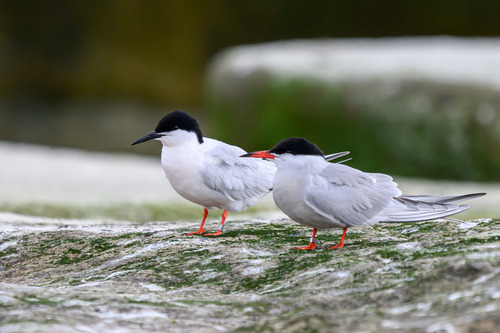
Common TernCommon Tern
Arctic TernArctic Tern

Three things. The bill: Common has a black tip, Arctic is all red. The neck and head: Common has a longer neck and a bigger head, Arctic is round-headed with a short neck. The wings from above: Common has a dark wedge on the outer primaries, Arctic has pale, clean wings with a thin black trailing edge.

Roseate Tern, adult adult
Photo: E. Slinn · CC BY-NC

Bird 4 of 8

Roseate Tern

Sterna dougallii

How to recognise it

  • Very pale, almost white above, with a pink flush on the breast in spring
  • Long white tail streamers, longer than the wings
  • Black bill with a red base, and a shallow, quick wingbeat
tail streamers The long outer tail feathers of an adult tern. They reach past the wing tip in Arctic and Roseate Terns.

Where and when

UK, IE: very rare breeding bird, on a few islands, from May to August. NL, BE, FR: very rare, mostly on the coast. DE, DK, NO, SE, FI: almost never.

Call A soft, two-syllable “chi-vik” and a harsh “aaach”. Recording: Irish Wildlife Sounds · xeno-canto

The ghost of the three: pale like a Sandwich Tern in miniature, with a long tail. Listen for the soft “chi-vik”, which no other tern gives.

Don’t confuse with: Common and Arctic Tern (this week): darker backs, and no pink flush.

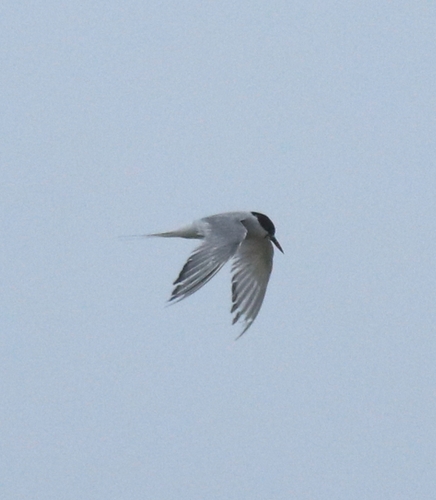
Little Tern, adult adult
Photo: deboas · CC BY

Bird 5 of 8

Little Tern

Sternula albifrons

How to recognise it

  • Tiny, with a white forehead patch on a black cap
  • Yellow bill with a black tip, and yellow legs
  • Very fast wingbeats, hovering before it dives
cap The black crown of a tern. In autumn it shrinks to a black mask with a white forehead.

Where and when

NL: uncommon on the coast. UK, IE, DK: scarce, on shingle beaches from May to August. BE, DE, FR, NO, SE, FI: rare, on the coast. Arrives in late April and leaves in August.

Call A high, sharp “kit-kit-kit” and a buzzing “zreek”. Recording: David Darrell-Lambert · xeno-canto

The size is the first thing you notice: the size of a starling. Its colonies on the shingle beaches are very exposed, and walkers and dogs are the main danger.

Don’t confuse with: Common Tern (this week): bigger, a red bill, and slower wingbeats.

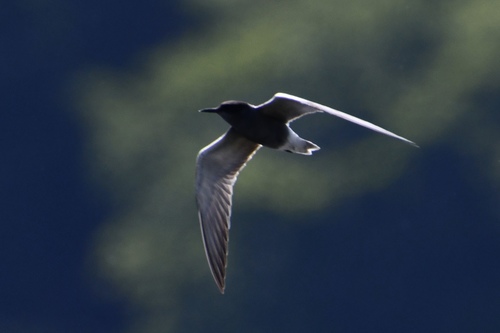
Black Tern, adult, non-breeding adult, non-breeding
Photo: rober025 · CC BY

Bird 6 of 8

Black Tern

Chlidonias niger

How to recognise it

  • Small and dark, with a grey back and a dark smudge on the side of the breast
  • A dark patch behind the eye, and a white forehead and underparts in autumn
  • A marsh tern: flies low over water, picking insects off the surface
marsh tern A tern of fresh water: Black, White-winged and Whiskered. They pick insects from the surface instead of diving.

Where and when

NL: uncommon, breeding in a few marshes from May. DE: scarce on passage. UK, IE, BE, FR, DK, NO, SE: rare on passage in May and from August to September. FI: very rare.

Call A short, sharp “kik” and a nasal “kreee”. Recording: Michel Veldt · xeno-canto

A marsh tern is not a seabird. In autumn it is the dark-backed small tern you see on a reservoir.

Don’t confuse with: White-winged Black Tern (this week): a pale grey back, white rump, and a black smudge only behind the eye.

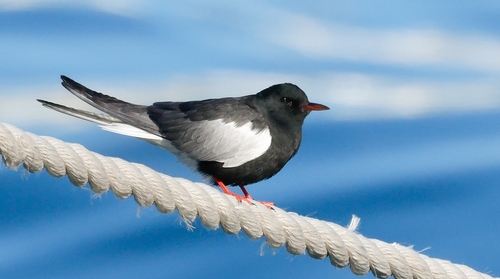
White-winged Black Tern, juvenile juvenile
Photo: Koray Öğreten · CC BY-NC

Bird 7 of 8

White-winged Black Tern

Chlidonias leucopterus

How to recognise it

  • Dark brown saddle contrasting with a pale grey wing, and a white rump
  • White underparts and a black patch behind the eye, with no dark on the breast
  • Flies low over water like a Black Tern, but looks cleaner and more contrasty

Where and when

NL, BE, DE, FR, DK, SE: rare, on passage in May and from late July to September. UK: very rare. IE, NO, FI: almost never.

Call A harsh “kesch” and a dry, rasping “kek”. Recording: Jarek Matusiak · xeno-canto

The juvenile has a dark brown saddle that stands out against a pale rump, a pattern that no other tern shows.

Don’t confuse with: Black Tern (this week): a grey back, a dark smudge on the breast side and a grey rump.

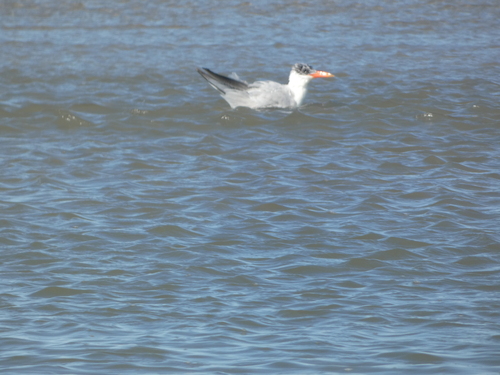
Caspian Tern, adult adult
Photo: Bruce Neville · CC BY-NC

Bird 8 of 8

Caspian Tern

Hydroprogne caspia

How to recognise it

  • The biggest tern, as big as a Herring Gull, with a huge red bill
  • Black cap and a heavy, powerful flight with slow wingbeats
  • Dark underside of the wing tip, a pale grey back, and black legs

Where and when

SE, FI: scarce breeding bird on the coast, May to August. NL: rare on passage. UK, IE, BE, DE, FR, DK, NO: very rare to rare, usually single birds on the coast or inland pits in spring and autumn.

Call A deep, hoarse “kraa-uk”, like a heron. Recording: Uku Paal · xeno-canto

You notice the size first, and the bill is the clincher. It is a rare bird in many of the ten countries and is usually on its own.

Don’t confuse with: Sandwich Tern (this week): smaller, a black bill with a yellow tip and a shaggy crest.

Quiz

12 questions, with birds you have to repeat mixed in. Your answers decide when each bird comes back.

Out and about this week

Look for terns this week on a beach, a pit or an estuary, ideally between May and September. For each one, check three things in this order: the bill (red or black-tipped), the length of the tail, and the shape of the head.