

マヒワ 対 ハタホオジロ
Spinus spinus 対 Emberiza calandra
マヒワとハタホオジロのクイズ
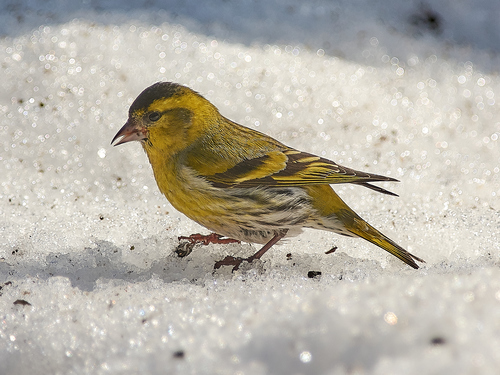 マヒワ
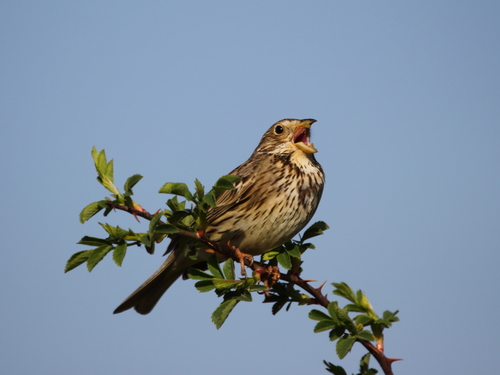 ハタホオジロ
要点
The most reliable field mark is overall color: Eurasian Siskin is a small, slim, vividly yellow-green finch with a black cap (male) or greenish head (female/juvenile), while Corn Bunting is a much larger, heavy-bodied, brown and streaky bird with no yellow, no cap, and a plain brown tail. In flight or perched, Siskin shows a bold yellow wing bar and yellow in the tail, contrasting with the Corn Bunting’s plain brown wings and tail. Juvenile and female Siskins can be confused with buntings at a distance, but even then, Siskin’s smaller size, slimmer build, and more active, acrobatic feeding behavior are clues. Corn Bunting lacks any bright colors and is always streaky and drab. If you see a yellowish, black-capped finch, it’s a Siskin; a large, streaky, brown bird with a heavy bill is a Corn Bunting.
識別のコツ
- Overall color: Siskin is greenish-yellow with black (male) or olive (female/juvenile); Corn Bunting is always brown and streaky, never yellow or green.
- Wing pattern: Siskin (all ages) shows a bold yellow wing bar and yellow sides to the tail; Corn Bunting’s wings are plain brown with white-tipped lesser coverts, no yellow.
- Head pattern: Male Siskin has a black cap and bib; female/juvenile Siskin has a greenish head with no cap. Corn Bunting has no cap or bib, just a plain, streaky brown head.
- Bill shape: Siskin has a short, fine, pointed bill; Corn Bunting has a large, thick, conical bill with yellowish mandibles, much heavier than Siskin’s.
- Body shape: Siskin is slim, short-tailed, and delicate; Corn Bunting is large, round-bodied, and heavy, with a longer, plain tail.
- Underparts: Siskin’s underparts are white with fine streaking (more on flanks, especially in females/juveniles); Corn Bunting’s underparts are whitish but heavily streaked all over, with a streaked gorget around the throat.
- Tail: Siskin’s tail is black with yellow sides and a black tip; Corn Bunting’s tail is plain brown, with no yellow or black pattern.
- Behavior: Siskin is acrobatic, often feeding upside down; Corn Bunting feeds on the ground or perches upright on posts or wires.
- Flight style: Siskin’s flight is rapid and bounding; Corn Bunting’s is heavier and more direct.
- Habitat: Siskin in woodland or at feeders, Corn Bunting in open farmland or grassland.
- Song: Siskin gives a lively, twittering song; Corn Bunting’s song is metallic and jangling.
- Sexual dimorphism: Siskin shows strong sexual dimorphism (male with black cap, female/juvenile duller); Corn Bunting sexes look alike, both dull brown and streaky.
- Size: Siskin is much smaller (13.8g, 11–12.5 cm) than Corn Bunting (16–19 cm, much heavier).
- Juvenile confusion: Juvenile Siskins are duller but still show yellow in wing/tail and a fine bill; juvenile Corn Buntings are just as streaky and brown as adults, with no yellow or green.
- Common pitfalls: Female/juvenile Siskins can be mistaken for buntings at a distance, but always check for yellow in the wing/tail and finer bill. Corn Bunting never shows yellow or a black cap, regardless of age or sex.
大きさ
Eurasian Siskin is much smaller and lighter (body mass ~13.8g) than Corn Bunting, which is a large, bulky bunting (no exact mass given, but length 16–19 cm vs Siskin’s 11–12.5 cm). Siskin is short-tailed and slim, while Corn Bunting is round-bodied and heavy, with a noticeably larger, thick bill. Even at a distance, Corn Bunting appears more robust and lark-like, while Siskin is delicate and agile.
羽色
-
Juvenile/immature birds: Juvenile Siskins resemble females, with drabber olive and yellow tones, but still show some yellow in the wing and tail, and a shorter, finer bill. Corn Bunting juveniles look like adults: brown, heavily streaked, with no yellow or green, and a plain brown tail and wings. No age-specific wing patterns are noted for either species, but Siskin (all ages) always shows a bold yellow wing bar and yellow in the tail, while Corn Bunting’s wings are plain brown with white-tipped lesser coverts.
-
Adult males: Siskin males are bright green and yellow with a black cap and bib, yellow supercilium, yellow rump, and a strong yellow wing stripe. Corn Bunting males are dull brown, heavily streaked, with no cap or bib, and a plain brown tail. Both sexes of Corn Bunting look alike, lacking any bright color.
-
Females: Female Siskins are more olive, with greenish head, yellow in the wing and rump, and a short, fine bill. Corn Bunting females are identical to males: brown, streaky, and plain.
-
Key contrast: Siskin always shows yellow in wing/tail and a finer bill; Corn Bunting is always brown, streaky, and heavy-billed.
行動
Siskins are active, acrobatic feeders, often hanging upside down on twigs or cones, and are sociable, moving in flocks. Their flight is rapid and bounding, typical of finches. Corn Buntings are more terrestrial, often seen perched upright on wires, posts, or low bushes, and feed mainly on the ground. Their flight is heavier and less bounding, and they rarely show acrobatic feeding behavior. Siskin’s agility and flocking habits are good behavioral clues.
生息環境
Eurasian Siskin is typically found in coniferous or mixed woodland, especially where alder and spruce are present, but will visit gardens and feeders in winter. Corn Bunting prefers open country with scattered trees, such as farmland, weedy fields, and grassland, and is rarely found in dense woodland. If the bird is in a forest or at a feeder in winter, Siskin is more likely; in open farmland, Corn Bunting is expected.
声
Siskin’s song is a pleasant mix of tweets and trills, typical of finches. Corn Bunting’s song is a repetitive, metallic jangling, often compared to jangling keys, and is given from a prominent perch. If you hear a metallic, mechanical song, it’s Corn Bunting; a lively, twittering song points to Siskin.